7 things you need to know about French e-invoicing and e-reporting


1. The scope is wider than you think
E-invoicing covers domestic B2B invoices between two French VAT-registered businesses. But France also requires e-reporting for everything outside that scope: B2C sales, cross-border invoices, and in some cases payment data.
Even if you have few French B2B customers, you may still have significant e-reporting obligations. Check your full transaction mix.
2. Every invoice passes through the government
France uses a clearance model (Continuous Transaction Controls). Every invoice must flow through a government-certified platform before it reaches the recipient. The platform validates the invoice and reports the data to the French tax authority (DGFiP) in real time.
No platform, no compliant invoice.
3. The full invoice lifecycle must be reported
Sending the invoice is just the start. France requires you to report every stage:
invoice created and sent
received by the recipient
recipient’s response
payment confirmed
Every status change goes to the DGFiP through your platform.
4. Recipients can formally reject an invoice
If an invoice doesn’t meet the required format or content rules, the recipient can formally refuse it using one of the government-defined reason codes (codes de refus). The refusal is transmitted back to the supplier via the platform.
As a supplier: fix your master data before you go live.
As a recipient: you don’t have to accept a non-compliant invoice.
5. A refused invoice does not need a credit note
When a recipient formally refuses an invoice through the platform, the supplier does not issue a credit note. The refusal cancels the invoice. The supplier simply corrects and reissues.
This only applies to formal refusals using official reason codes, not to disputes on already-accepted invoices.
6. Non-compliance comes with penalties
The reform is legally mandatory. The French National Assembly rejected a further postponement in April 2025. The September 2026 deadline stands. Penalties apply for businesses that fail to meet their e-invoicing and e-reporting obligations.
7. You need to register an e-invoice address in the French directory
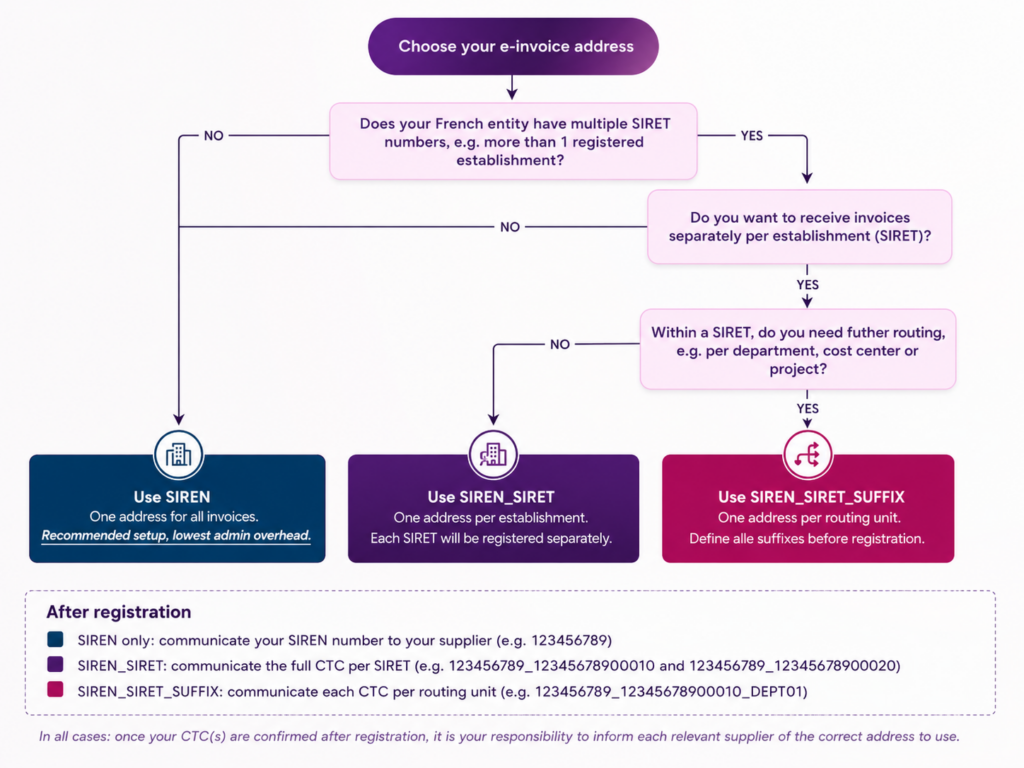
Every company in scope must register an electronic invoicing address in the French Annuaire (the central directory). This is the address your suppliers use to send you e-invoices. You have three options:
One address for your entire entity. Simple, recommended for most companies.
A separate address per establishment. Useful if you have multiple sites with independent accounting.
An address per internal routing unit (department, cost centre, project). Only needed when one SIRET requires further invoice routing.
Not sure which option fits your situation? We handle the registration and advise you on the right setup.